Part Two - The Idea I Cannot Stop Thinking About
A simple rule for deciding when quantum earns its place, what it means for an organisation deciding when to act, and the software that might one day apply the rule for us.
Where we are. In Part One I walked through the architecture a quantum computer inherits from sixty years of classical computing: six layers, a new accelerator that slots in beside the CPU and the GPU, and a bandwidth wall between the warm and the cold. I also wrote down the test I keep coming back to: not the fastest computer, not the biggest, but the one that gives an answer worth more than the cost of getting it. This part turns that sentence into a rule you can use.
The question underneath every quantum conversation
Over a great many conversations with scientists, engineers and the people who sign the cheques, I have arrived at a conviction. The next big thing in quantum is not only a better qubit, or even the first truly useful logical qubit, important as both are. It is a decision rule: a disciplined, repeatable way of answering one question for any given piece of work.
Does this belong on a quantum computer at all?
It sits underneath almost every quantum conversation I have been part of, and it is almost never asked out loud. People ask whether quantum "works", when it will "arrive" or which hardware will "win", none of which tells a leadership team what to do on Monday morning. So I answer the underlying question with something I call the ROI gate, ROI as in return on investment. It is simple enough for the back of an envelope and, I hope, rigorous enough to survive a room full of physicists.
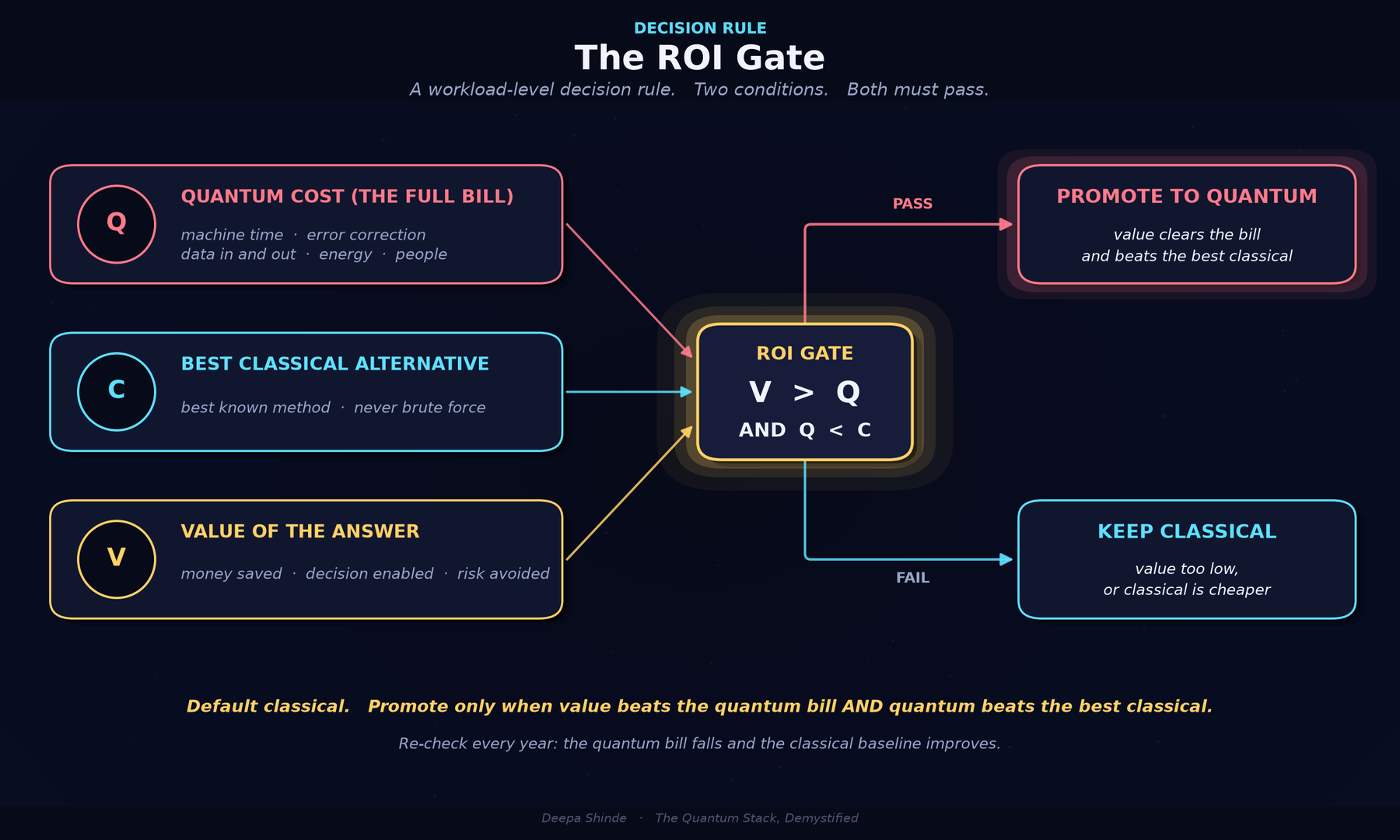
Take one workload. In practice that means a well-defined calculation inside a bigger workflow, not a whole application. Define three quantities. V is the value of the answer: money saved, a decision enabled, a material discovered, a risk avoided. It has a date attached, because an answer that arrives after the decision has been made is worth very little. Q is the full cost of getting that answer from a quantum computer, which is much more than machine time. C is the cost of getting an equally good answer, at the same accuracy, confidence and deadline, from the best classical method available. Not brute force. The best.
The workload earns a place on the quantum machine only when V is greater than Q, and Q is less than C. Both conditions. Either alone is not enough. Where the two routes give answers of different quality, the fuller version compares what is left after paying: the value of the quantum answer minus Q has to beat the value of the best classical answer minus C, and has to beat doing nothing at all. Put all three numbers on the same footing: the same currency, the same date and the same discounting.
Default classical. Promote to quantum only when value beats the quantum bill, and quantum beats the best classical.
Quantum advantage is usually framed as "cannot be solved classically". The gate asks a priced question instead, for a single workload inside an organisation: a value with a date on it, the full quantum bill, and the best classical method available, priced at the same accuracy and deadline. Of the two conditions, the second is where nearly every promising idea is won or lost, because it moves.
Reading the gate properly
Cost, upstream and downstream
Written in shorthand, V > Q and Q < C, the gate can read as if quantum only wins by being cheaper. I mean cost in the broad, scientific sense, so let me say so upfront. An advantage can show up in two places. Upstream is the cost of getting the answer: quantum produces the same answer for less, so Q falls below C. Downstream is the cost of what happens because of the answer. A better, more trustworthy or more timely answer avoids costs later, such as a drug candidate dropped before an expensive trial, or a catalyst found years sooner. That downstream advantage lives in V, and it is exactly what the fuller version above weighs.
Downstream costs are paid in different currencies: money, time, health and human progress. Price them where you can, on the same footing as everything else. Some resist pricing, scientific understanding above all; there the gate can inform the decision but not make it, and I would rather say so than force a number. And a better outcome is not an escape route for a proposal that fails on cost. The better answer has to beat the best classical answer, not no answer at all.
Upstream, quantum gets the same answer for less. Downstream, it gets a better answer, and the saving comes later.
Q is the whole bill, not the qubit count
People usually quote the cost of a quantum computation in qubits, which is a little like pricing a flight by the number of seats. The real bill includes error correction, which can take from dozens to more than a thousand physical qubits for every reliable logical one; the classical computing that decodes errors and steers the machine in real time; getting data in and answers out; the repetitions needed for a trustworthy result; verifying the answer; the energy; and the scarce specialists who make it all happen. Skills and access are fixed costs, to count once across a portfolio rather than charge to every run.
It helps to know what that overhead buys. On the best full-size machines, two-qubit operations now fail a little less than once in a thousand, and small laboratory devices have reached about once in ten thousand, yet a useful chemistry calculation needs billions of steps without a fault. So the field builds logical qubits: many physical qubits held together by an error-correcting code, which a programmer can treat as reliable.
Two items quietly kill most proposals. The first is data. A quantum computer takes in data far more slowly than a GPU, by several orders of magnitude, so problems that need a lot of data in or out tend to fail the gate before they start. In Part One I called the QPU the new GPU; that is true of where it sits in the stack, not of how you feed it. The second is speed-up. Error-corrected operations are slow next to a classical chip, so a modest advantage gets eaten by the overheads. A careful 2023 analysis concluded that quadratic speed-ups, the kind promised for search and many optimisation problems, will not be enough in practice. You need better than quadratic, on a problem with small inputs and outputs. In gate terms: big compute, small data and a structural advantage, or Q will not get below C.
C is the best classical method, not the convenient one
This is the trap I see most often. Beating brute-force classical simulation proves almost nothing, because brute force scales terribly. The real competitor is the cleverest approximation a strong classical team would use: coupled-cluster and tensor-network methods in chemistry and physics, specialised solvers in optimisation and, increasingly, AI models trained on accurate data.
There is a well-known cautionary tale. In June 2023 IBM published a 127-qubit experiment as evidence that quantum computers could be useful before full error correction. Twelve days later a research team posted a classical tensor-network simulation of it, one of several. In March 2025, as D-Wave published an advantage claim made with its quantum annealer, the same team posted a classical simulation of much of that too, using modest computing resources; it appeared in Science in May 2026. D-Wave disputes that it reaches the hardest cases, and that argument is still running. Neither was a failure of the experiments. It was the gate doing its job. Classical methods move, and they move fastest when someone hands them a target.
So, a habit worth keeping: if someone tells you C is effectively infinite, ask who tried, with which method, and when. Sometimes the claim is true; more often nobody strong has tried yet. And price both sides the same way, because the classical route has specialists too, and its own cost of checking an approximate answer.
The gate has a clock
Both sides of the inequality move, and both usually fall. What matters is which falls faster. The clearest example is breaking RSA-2048 encryption. On the same assumed hardware, the estimated machine fell from about twenty million noisy qubits in 2019 to under a million in 2025, through better algorithms and cleverer error correction alone, although the run itself grew from about eight hours to under a week. A 2026 preprint using newer, more connected error-correcting codes claims under a hundred thousand. None of these machines exists yet and the newest figure is not yet peer reviewed, but the direction is hard to miss. Part Three follows that story.
So the gate is not a line you draw once. You evaluate it at the date a machine could actually run the job, you re-check it every year, and you treat every number as a range. Because both sides are soft, my rule of thumb before committing serious money is that the gate should pass on cautious numbers: the pessimistic Q below the optimistic C, and the low-case V still comfortably above Q. In practice that usually means a margin of something like ten times. That is a judgement, not a law. I would rather be a year late than a decade early.
There is a second clock, and it belongs to you. Getting ready takes time: framing the problem, cleaning the data, building a classical baseline you trust, growing a small team and agreeing terms with a provider. Cryptographers met this first, and wrote it down more than a decade ago as a simple inequality: if the years your data must stay secret plus the years your migration will take exceed the years until a machine can break your encryption, you already have a problem. Part Three comes back to it.
Turned round from threat to opportunity, the same arithmetic answers the question I am asked most often: when should we start? If the gate looks five years away and you could be ready in two, you can afford to watch. If getting ready would take six, you are already late. I call this the gate clock. It tells you when to start the small, cheap work of Prepare, not when to commit serious money; the margin above still governs that. Both of its numbers are guesses, so write them as ranges and revisit them every year.
Start preparing when getting ready would take longer than the gate is likely to stay shut.
Ten questions through the gate
Here is the gate run on real questions, with published numbers. I ran it ten times, across industries and science. Five are the questions I am asked about most. The other five I chose because they were the strongest cases I could find for quantum computing doing something classical computing cannot, with something that matters riding on the answer. The rules were the same every time: published numbers wherever they exist; every input a range; computing costs only, on both sides; a million simulated combinations, in five separate runs; and a check of each from three standpoints: quantum computing, the field itself and the business case. Where the two sides were not on quite the same footing, I let the mismatch favour quantum. All money is in 2025 US dollars.
The biggest assumption is the price of an hour on a machine that does not yet exist. A fault-tolerant machine costing one to three billion dollars, paid off over five to ten years at a 7 to 10.5 per cent cost of capital and running day and night, would cost roughly $16,000 to $91,000 an hour before running costs, idle time or margin. So I used $15,000 to $150,000 an hour for every example that needs such a machine. The simulations show how the ranges combine, not that they are right.
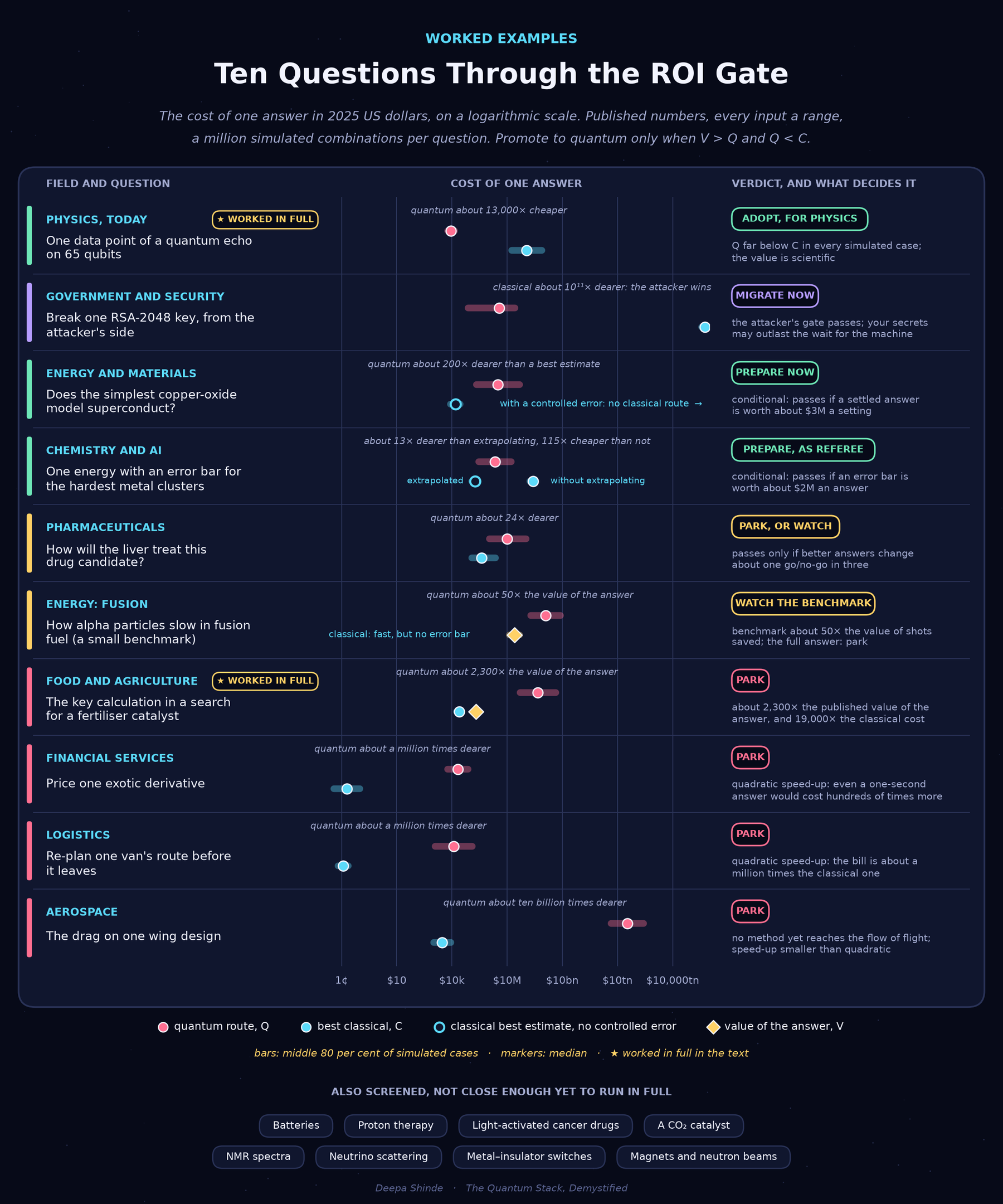
Read down the right-hand side of Figure 2 and a pattern appears. The failures fail for reasons this part has already named: a speed-up that is only quadratic, which loses on cost before any deadline bites, in finance and logistics; the data wall, and a speed-up smaller still, in aerospace; a downstream value nobody has measured, for the drug candidate; and a single answer that costs far more than it is worth, however large the prize behind it, for fertiliser and fusion. Most were settled by the classical baseline, which is why I keep asking for it first; fertiliser and fusion were settled by the value.
The passes share a different shape. They are small quantum problems with a handful of numbers out, and their advantage comes from simulating quantum mechanics directly rather than from a quadratic speed-up. Two of them, the superconductor and the hardest metal clusters, sell certainty rather than speed: they pass only if someone values an answer with a controlled error above a break-even price of about $2 million to $3 million, so for those I have priced the bar, not the value. Their first buyers would be referees rather than producers: physicists, research funders and national laboratories. And the one gate that passes outright on money is an attacker's, which is why post-quantum migration should not wait for our own gate.
I take two of the ten through in full: the two whose working I trust most not to mislead. In each, the numbers that decide the verdict come from the published study itself rather than from my judgement, and the verdict holds in every one of the simulated cases. One is an Adopt and one a Park, and between them they show both halves of the gate at work.
Adopt: an echo no supercomputer has yet matched
In 2025 a team used 65 qubits of a 105-qubit chip to run a quantum system forward, nudge one qubit, run it backwards and measure the echo, a quantity physicists use to study how information spreads and scrambles inside a quantum system. It was published in Nature, and it was designed to be checkable: by another quantum computer of the same calibre and, eventually, against nature itself. Suppose a physics group wants more data points like these. Should it buy them from a quantum computer or from a supercomputer?
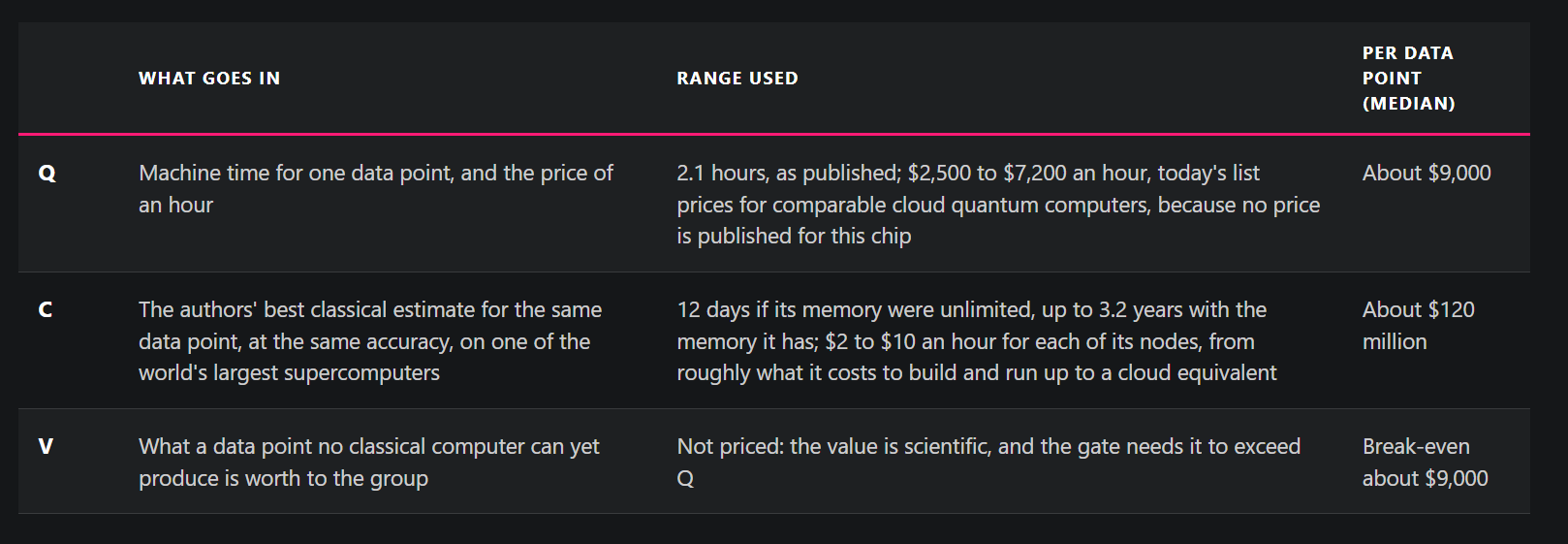
Q is below C by a factor of about 13,000 at the median, and by at least 360 in every simulated case. On cautious numbers, setting the dearest quantum case against the cheapest classical one in the middle 80 per cent of the range, the margin is still about 1,300 times, far above the ten times I asked for earlier before committing serious money. I re-ran the simulation ten more times with fresh random numbers for this version, and the medians moved by less than 2 per cent.
What could go wrong is cleverer classical methods. Classical estimates for earlier quantum experiments have later fallen by many orders of magnitude, and the figure here is a projection for an exact simulation rather than a run; an approximate method would only need to match the experiment's own noise. If classical methods became 1,000 times cheaper, the gate would still pass in about 97 cases in 100; if they became 10,000 times cheaper, it would fail in more than four cases in ten. So far the claim has held. As I write, no classical simulation or spoof has been published, a 2026 analysis found that one family of classical methods not tested in the original paper cannot feasibly simulate it, and a simplified version of the problem has been posed as an open challenge to classical attackers. Two caveats remain: exact classical checks reached only about 40 of the 65 qubits, and the reported values pass through error mitigation; and checking the result on a second quantum computer, the property that makes it verifiable, has not yet been shown in public.
V is the weak leg, and I would rather say so. The circuits were chosen to be hard to simulate, not to model any material, so the value is scientific. A companion study used echoes measured by NMR, with simulations, to infer distances inside real molecules, but at a scale classical computers can still handle. So the gate passes today for a research group that values data no classical computer can yet produce at more than about $9,000 a point, and for nothing yet in business. Adopt, for physics groups that can get time on a chip of this calibre, and keep re-checking the classical side.
Upstream it passes by four orders of magnitude. What is left is what the answer is worth, and today only science is asking.
Park: the catalyst that could make fertiliser cheaply
Making ammonia, most of it for fertiliser, uses about 2 per cent of the world's final energy and directly emits about 450 million tonnes of carbon dioxide a year, mostly from making the hydrogen rather than from the heat and pressure. A catalyst that worked at ordinary temperatures and pressures, especially one that could use hydrogen made from water, would be one of the most valuable discoveries imaginable, and it is the example I am asked about most. So take a research programme searching for molybdenum catalysts that fix nitrogen. Should it run its most valuable calculation on a quantum computer?
Here, unusually, someone has already priced the answer. A 2024 study by a quantum software company and university chemists took the most useful calculation in that search, two steps of a catalytic cycle that turns nitrogen into cyanate, and estimated three things: the economic value of running it, the time it would take on a fault-tolerant quantum computer, and the cost of an equivalent classical calculation. All three legs of the gate come from one published source.
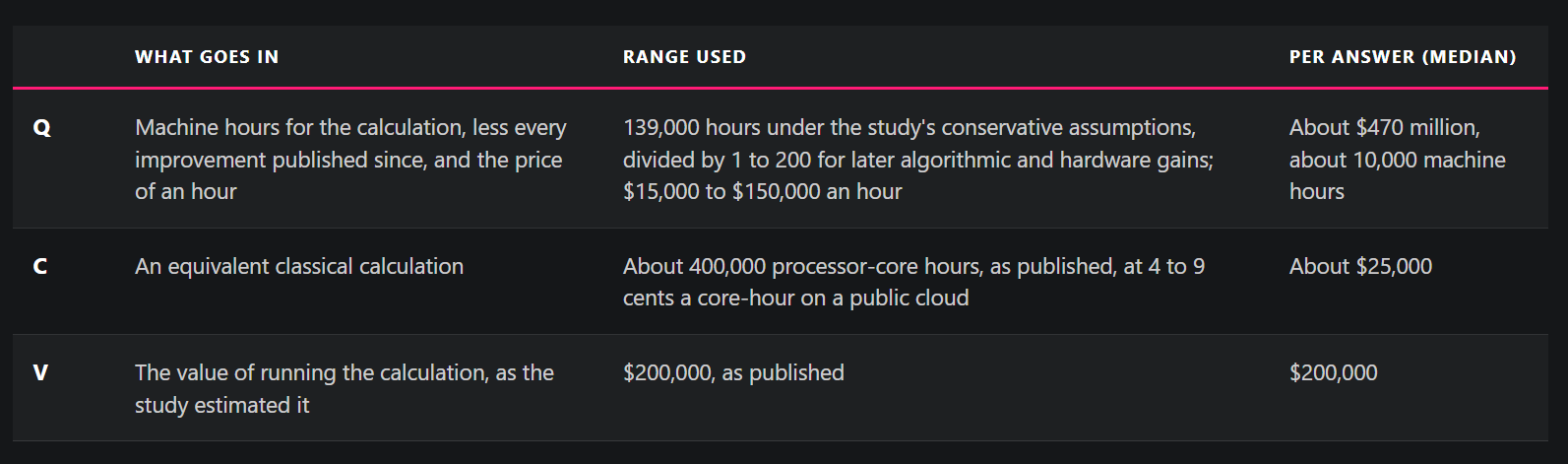
One answer costs a median of about $470 million: about 2,300 times its value, and about 19,000 times the classical calculation. It fails both conditions in every simulated case. Even in the kindest corner, with every published improvement and the cheapest hour, it costs more than 50 times its value. Re-running with fresh random numbers moved the medians by about 2 per cent at most.
What could change it? Two things, and neither is close. The first is progress. The operations needed for the flagship nitrogen-fixing cluster have fallen by four to five orders of magnitude in eight years, through better algorithms rather than better hardware, but most of that came in the first few years. At the pace since 2021, about two and a half times a year, the gap to the value would take about nine years to close, and the gap to the classical calculation longer still, because classical methods improve too. The second is a bigger decision. The study priced the answer as one step in a research programme; an answer that sat in front of, say, the decision to build a pilot plant would be worth far more. Its authors read their results as a case for continued development, and I agree: the gate says when, not whether.
This is the clearest example of something this part keeps returning to. V is not the prize; it is the value of the answer to the decision in front of you. The prize behind ammonia is vast, but one calculation moves one research programme a modest distance, and that is what the gate has to price. Park, and look again as estimates fall.
The prize is vast; the answer in front of the decision is worth $200,000. The gate prices the answer, not the prize.
What this means for an organisation
The question I hear most from leaders in government and large institutions is not "how does it work?" but "when should we do something about it?" The calendar is the wrong place to look. The gate is the right place.
Start with an exercise, not a strategy
Pick the five to ten problems your organisation genuinely cares about, where better computation would change a decision. For each, write down V: what a definitive answer would be worth, and by when. Ask for an estimate of Q from people who can run a resource estimate, with the assumptions written down. Then ask your strongest classical computational scientist for C: what the best classical approach can already do, and at what cost. The step from a business problem to a workload, the specific calculation inside it that quantum might help with, is where you need both kinds of expert in the same room.
In the public sector V is harder to price, but not impossible. HM Treasury's Green Book already asks departments to value costs avoided, risks reduced and social benefits over time, and the same discipline works here, as a range with its assumptions written down. If V cannot be estimated even roughly, that is an answer too: for now it is a research question, not an adoption decision.
I would expect most problems to fail the gate cleanly, as most of the examples above do. That is a good outcome, not a disappointing one; one or two may land close to the line, and those deserve attention. The exercise also turns a debate about belief into a conversation about evidence and cost. I have written it up as a short workshop method, the Quantum Portfolio ROI Assessment, for anyone who wants to run it. Part Three runs the gate on more problems.
Four postures, set by the gate rather than the calendar
Once through the gate, each workload falls into one of four postures, each with a different and mostly modest level of spend.
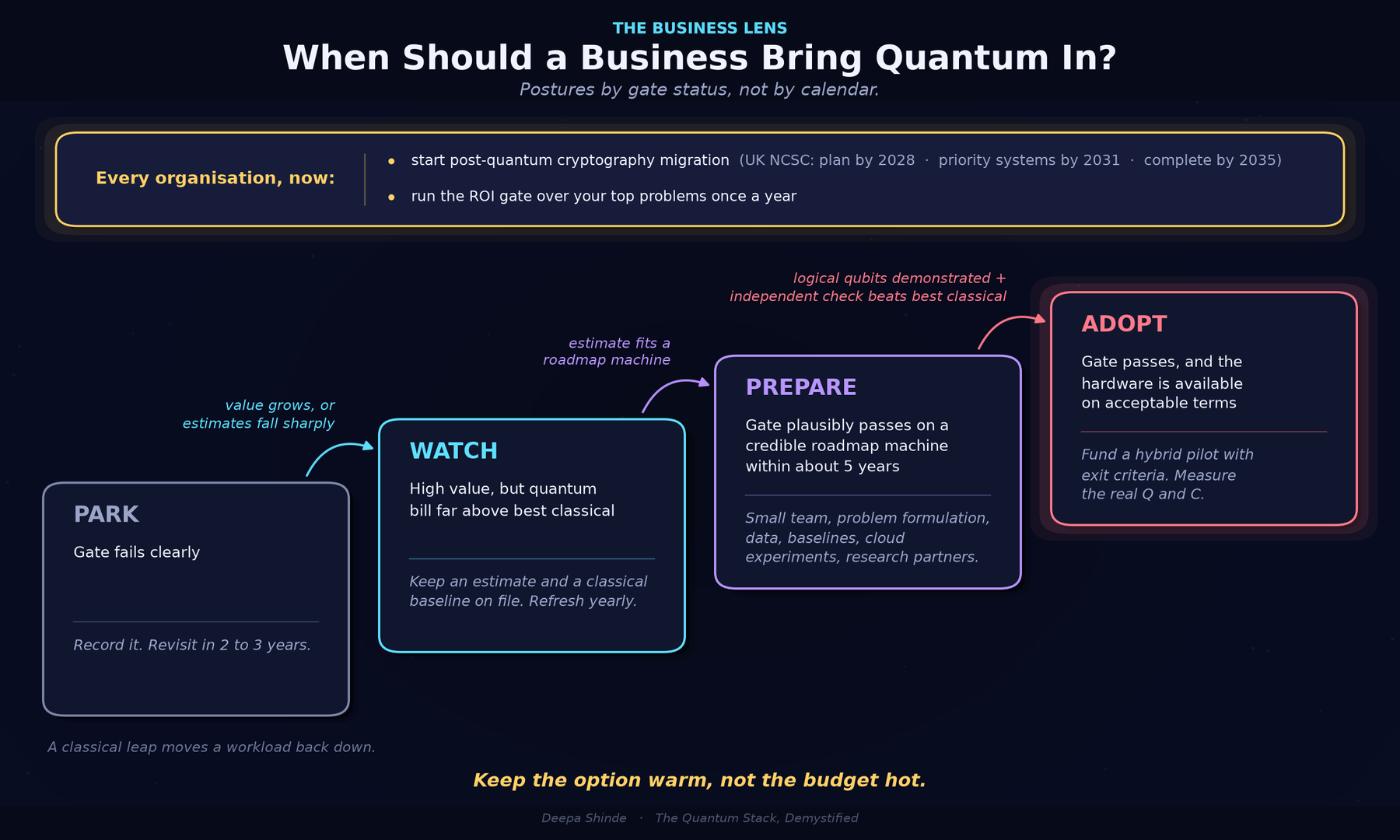
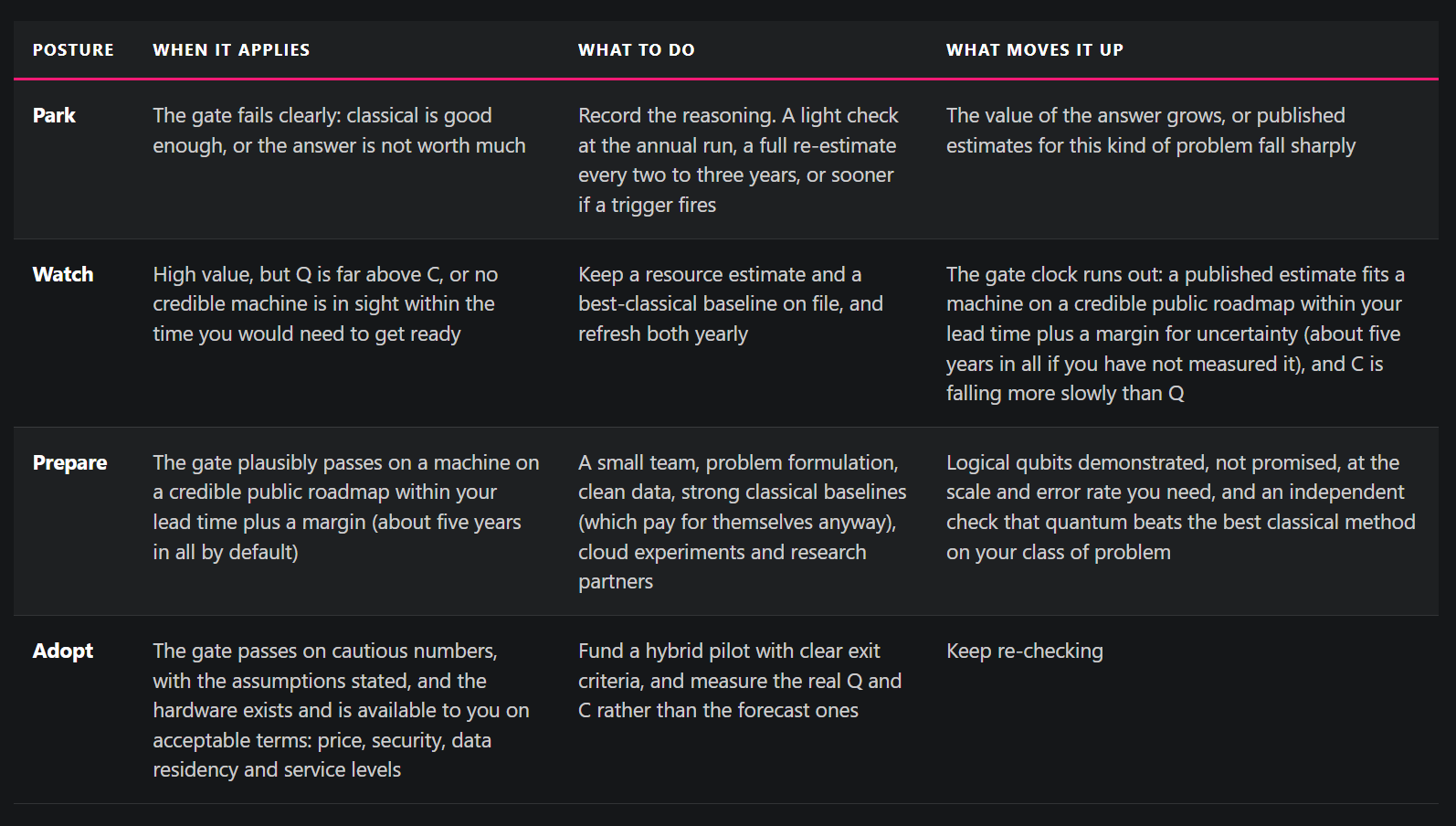
The arrows run both ways. A classical breakthrough can move a workload from Prepare back to Watch overnight, and that should be celebrated: you got your answer more cheaply.
Notice what is missing from the table: dates. Roadmaps matter (IBM is aiming for about 200 logical qubits running 100 million operations by 2029), but a roadmap is a promise and the gate asks for evidence. The triggers are observable: demonstrated logical qubits and error rates, estimates published for your type of problem, and advantage claims that survive independent classical challenge. An open Quantum Advantage Tracker, started in November 2025, now lets such claims be tested in public, and marks as superseded the ones classical progress has since overtaken.
Public funders now ask the same economic question. DARPA's Quantum Benchmarking Initiative is testing whether any approach can reach utility scale, computational value exceeding cost, by 2033. In October 2026 it moved four more companies into its final, hardware-testing stage, alongside two already there. The UK's first quantum mission, set in 2023, aims by 2035 for accessible, UK-based quantum computers "supporting applications that provide benefits well in excess of classical supercomputers". Well in excess of classical supercomputers is the second half of the gate, written into national policy. I take a quiet comfort from that.
Who owns it, and what it costs
A posture is only useful if someone owns it. I would give the gate to one named senior owner (a CTO, chief scientist or chief digital officer, or in a government department the chief scientific adviser working with the digital lead), with the CISO owning cryptography. Ring-fence a small budget for resource estimates from people who are not selling hardware. Buy access through existing cloud contracts, without multi-year hardware commitments and with clear terms on intellectual property and data (I wrote about the switching costs nobody budgets for in an earlier piece). And give every vendor claim five questions:
- Which classical method was it compared with, who chose it, and when?
- Were both answers held to the same accuracy?
- Are the time and cost end to end, including data in and out and verification?
- Where are the error bars?
- Has anyone independent reproduced it?
Two things every organisation should do now
Two actions do not wait for any gate, and neither is a posture. The first is post-quantum cryptography: replacing vulnerable public-key cryptography with the standards NIST published in August 2024, a classical programme with UK target dates of 2028, 2031 and 2035, which Part Three covers in full. The second is to run the gate itself, once a year, across your most important problems. It costs a few weeks of good people's time, builds the literacy you will need, and means that when a trigger fires you already know which problems it touches.
Everything beyond those two is optional. Prepare spending, by definition, does not pass today's gate, so think of it as an option premium: a small, known amount paid now for the right to move quickly if a trigger fires. Size the premium to what being late would cost you, not to what a vendor would like you to spend.
Keep the option warm, not the budget hot.
The cost of being early is a pilot with no path to a return, and a board that stops listening. The cost of being late, outside cryptography, is mostly the time it takes to build skills and data, which is exactly what the premium buys.
Three mistakes are worth naming. The first is expecting a production return from a pilot on today's noisy hardware. Scientific advantage claims have arrived since 2025, and in July 2026 IBM and its partners declared quantum advantage outright, which is genuinely exciting. Within a fortnight a classical team had reproduced one of those experiments on GPUs in under forty minutes; others are still standing. None yet is a business problem with an independently checked cost advantage. The second is comparing a quantum result with your own current code rather than the best classical method; that measures your technical debt, not quantum's advantage. The third is feeling you must pick a hardware winner now. You do not, as the next section explains.
If you automate the gate, you get a router
Run the gate by hand and it is a discipline you can start this quarter. Here is the part that is genuinely speculative, a bet rather than a finding: what if the gate became a layer of software? The programmer would describe the problem. A quantum-aware orchestration layer, which I will simply call a router, would apply the gate to each workload and decide where it runs (CPU, GPU, an AI accelerator or a quantum processor) without the application needing to know.
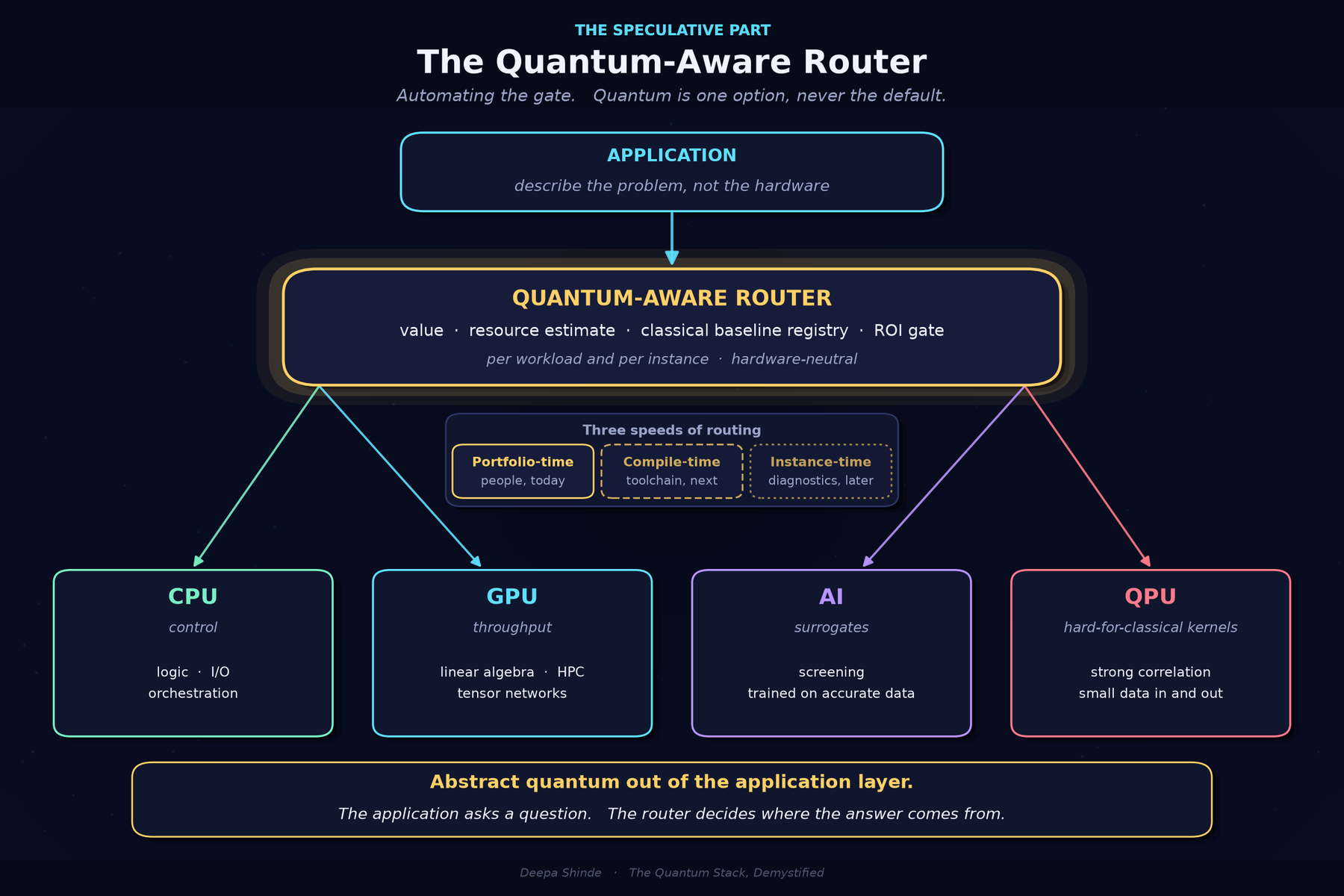
I do not mean a job scheduler, and I do not mean moment-to-moment hand-offs of the kind a CPU makes to a GPU: data goes into a quantum computer slowly, and a serious fault-tolerant chemistry calculation may run for days on the fastest designs and for weeks or months on others. So I think the router arrives at three speeds.
The first is portfolio-time: people apply the gate once a year, as above. It exists today, in spreadsheets and meeting rooms. The second is compile-time: when a program is built, the toolchain weighs a resource estimate for the quantum route against a recorded cost for the best classical route and picks a target for each workload. Every ingredient exists; nobody has yet assembled them around value. The third is instance-time: the router looks at each specific input. Most molecules are handled well by classical chemistry, and diagnostics can flag the strongly correlated minority that may not be, though cheap ones often disagree with one another. A flag is a reason to look, not proof that quantum will win, but it is the most powerful version and the furthest away.
One simplification is worth saying out loud: at compile-time and instance-time the answer is usually worth the same whichever machine produces it, so the router simply looks for the cheapest route that meets the accuracy and the deadline. V does its real work at portfolio-time.
What already exists, and what I am adding
Choosing the right implementation for each problem is an old idea in computing, and today's hybrid toolchains already treat the quantum processor as one accelerator among several, though the developer still names the target.
What I have not found is a published policy that weighs a dated value, the full quantum bill and the best classical cost together. That narrow piece is what I am proposing, and it has a dependency that gets far less attention than it deserves. The router's hardest input is not quantum at all. It is an honest, shared record of what the best classical methods can do, and at what cost.
So I would love to see a classical baseline registry, in the spirit of the benchmark suites that keep AI and supercomputing honest, held by a neutral body rather than a vendor (in the UK, a national laboratory working with the National Quantum Computing Centre would be a natural home). Each entry would record a public problem instance, the accuracy, the method, the hardware and time, the energy, the cost at a dated price, the code, and who ran it and when, with an open route to challenge it. It would gain teeth the day funders and buyers asked every advantage claim to point to an entry. What no public record holds yet, as far as I can find, is what the classical answer costs, in money and energy, at a stated accuracy and deadline.
What it stands on
None of this works unless a few parts of the stack hold still long enough to build against. I trust three, and they are exactly the seams a router would use.
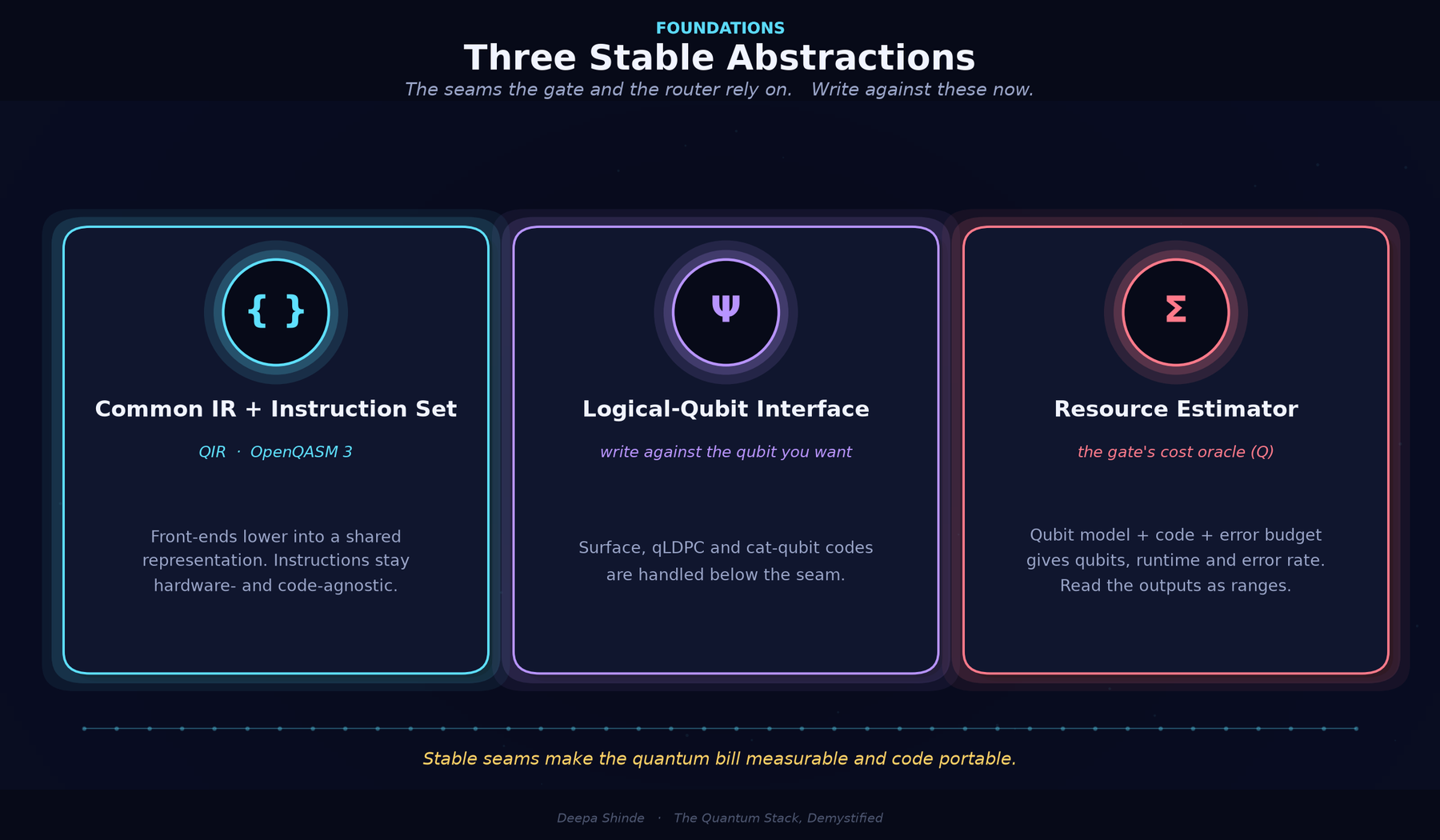
The first is a common intermediate representation, the hinge from Part One: QIR, built on the LLVM compiler infrastructure, or OpenQASM 3, used by IBM and Amazon. The principle that matters is an instruction set that hides both the hardware and the error-correcting code, so a program survives a change in either; today's formats are not fully there yet. The second is the logical-qubit interface: you write against reliable logical qubits, and the error correction happens below the seam, whatever code or qubit sits underneath. The third, carrying the most weight, is the resource estimator, which tells you before you run a program how many physical qubits it needs, how long it takes and what error rates the hardware must reach. Microsoft, Google and IBM each publish one, and academic groups have their own. Without an estimator there is no Q, and without Q there is no gate. Read the outputs as ranges with their assumptions attached.
A resource estimator is what turns a thought experiment into a decision.
There is a practical bonus. A router that routes on the gate lowers the stakes of the hardware race: you write against stable abstractions and let the decision follow the evidence, with an estimate for each kind of hardware, because the same program can differ by orders of magnitude in runtime between them.
To gather the threads, what I am proposing is narrow, and I hope sharp: the gate as a two-part test for a single workload, with a dated value, the whole quantum bill and a priced best classical method at the same accuracy, with cost read both upstream and downstream; a gate clock that turns the cryptographers' inequality from threat to opportunity; postures and triggers read off the gate rather than the calendar; a router that would apply the gate at three speeds; and the missing columns of cost and energy in the classical record that everything else depends on.
The gate and the clock are the parts I would defend longest. The router is a bet, placed in public so it can be argued with; Part Four sets out what would prove each of them wrong.
The application asks a question. The router decides where the answer comes from.
Coming next
That is the idea: a gate, the postures it gives an organisation, and a router that might one day automate it. An idea that cannot be tested on real problems is only a diagram, so in Part Three I take it to the applications I am asked about most: chemistry, where quantum may pay off; cryptography, where it bites; and optimisation, finance and AI, where you are most likely to be pitched it.
Previous: Part One - The Architecture You Inherit
Influences and thanks
My thanks to Dr. Matthias Troyer, for the definition of utility scale; the economists who price quantum against classical computing; Michele Mosca, for his inequality; the team at the Flatiron Institute for the cautionary tale's classical simulations; and the many others I have learned from over several years.
I work at Microsoft. The views here are my own, as are any errors of interpretation.